Note
Go to the end to download the full example code.
Analysis of simulated MRWs#
The pymultifracs package estimates the multifractal properties of time
series. This is an example using simulated Multifractal Random Walks which
covers all steps of the multifractal analysis procedure and gives an overview
of the toolbox’s features.
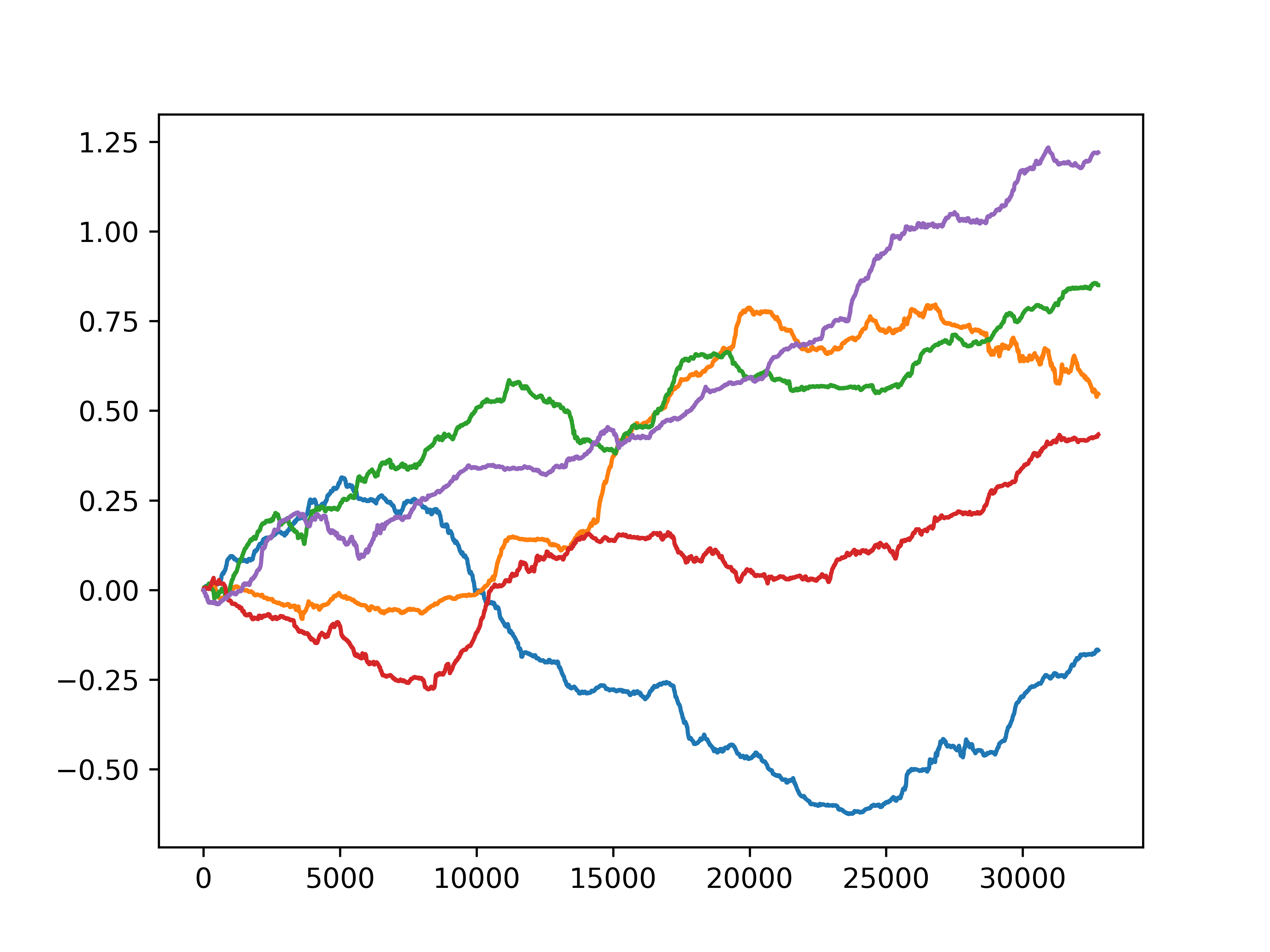
Let us first generate a few Multifractal Random Walks with parameters \(H = 0.8\) and \(\lambda=\sqrt{0.05}\)
Wavelet transform#
Wavelet transform is performed the pymultifracs.wavelet_analysis()
function
Parameters:
wt_name: The discrete wavelet to use, following the convention of the
pywavelets package.
j2: The largest scale to analyze, by defaultNonewhich means that
the analysis is carried to the coarsest possible temporal scale. The motivation for setting a lower value is to reduce the computation time and memory footprint.
normalization: Normalization norm for the wavelet coefficients: takes
the value of \(p\) to define the \(p\)-norm used in normalization. Defaults to 1 (\(1\)-norm) which is appropriate for scale invariance analysis.
Multivariate time series, such as we are dealing with here, are passed with the shape (n_samples, n_channels)
from pymultifracs import wavelet_analysis

WT = wavelet_analysis(X, wt_name='db3', j2=None, normalization=1)
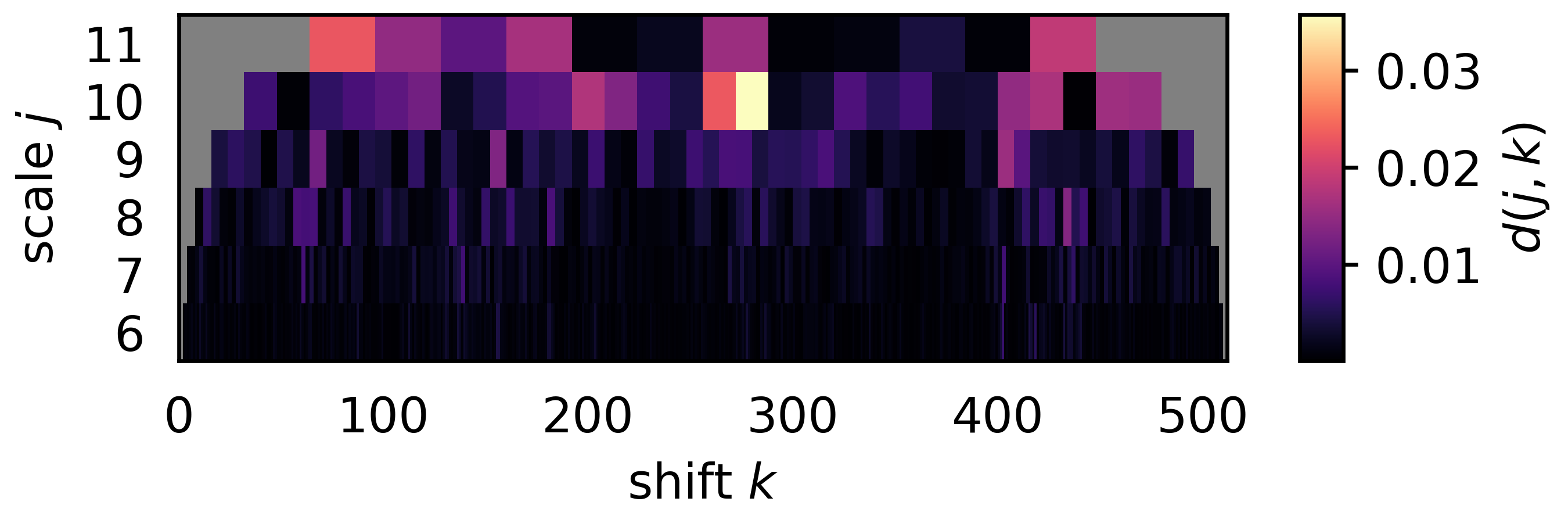
The output is a WaveletDec object, which contains the wavelet
transform of the time series.
It may be visualized using the plot method, specifying j1 and j2,
the lower and upper bounds on the scales temporal scales displayed,
respectively.
WT.plot(j1=6, j2=11)
Multi-resolution quantities derived from the wavelet transform can be
obtained using the associated methods WaveletDec.get_leaders() and
WaveletDec.get_wse():
WTL = WT.get_leaders(p_exp=np.inf)
WTpL = WT.get_leaders(p_exp=2)
WSE = WT.get_wse(theta=0.5)
Multifractal Analysis#
Multifractal analysis relies on regressing a linear relationship between the
temporal scale \(j\) and statistical quantities that are a function of
\(j\). The range of scales over which the regression is performed,
usually chosen as the range of scales for which the data is scale-invariant.
The scaling_ranges argument is a list of tuples indicating the bounds of
the range of scales to use for regression. Multiple scaling ranges may be
regressed at once by providing multiple tuples:
scaling_ranges = [(2, 8), (3, 8)]
Minimal regularity#
In order for the analysis to be meaningful under the chosen multifractal
formalism (wavelet coefficient, wavelet (p-)leader, etc.) it may be necessary
to verify a minimum regularity condition.
The method WaveletDec.check_regularity() is available with all
multi-resolution quantities, and takes scaling_ranges as an argument:
In case the minimal regularity is too low, it may be necessary to fractionally integrate the time series.
A simple approach is provided in the WaveletDec.auto_integrate()
method, which will try to find a fractional integration coefficient large
enough that all signals may be analyzed, and return the properly integrated
multi-resolution quantity.
Otherwise, and for instance in the case where multiple sets of data need to
be compared using the same integration coefficient, the fractional
integration can be set using the WaveletDec.integrate() method on a
MRQ object by passing the fractional integration coefficient \(\gamma\):
WT_int = WT.integrate(.5)
Analysis#
Multifractal analysis is carried out using the mfa() function.
Basic parameters:
mrq: Multi-resolution quantity (WaveletDec,
WaveletLeader, WaveletWSE) on which to perform the
analysis.
weighted: whether the linear regressions should be weighted. Defaults
to None, which means no weighting is performed. "Nj" indicates that the
weights are determined from the number of coefficients at each scale.
q: list of moments.
Note
by default, mfa() checks the regularity of the time series.
It is possible to disable this by passing check_regularity=False.
from pymultifracs import mfa
from pymultifracs.utils import build_q_log

pwt = mfa(WTpL, scaling_ranges, weighted='Nj', q=[-2, -1, 0, 1, 2])
The function outputs a MFractalVar object, which contains:
structure: the structure functions (StructureFunction) and
associated exponents
cumulants: the cumulant scaling functions (Cumulants) and
log-cumulants
spectrum: the multifractal spectrum (MFSpectrum)
Plotting#
Structure functions
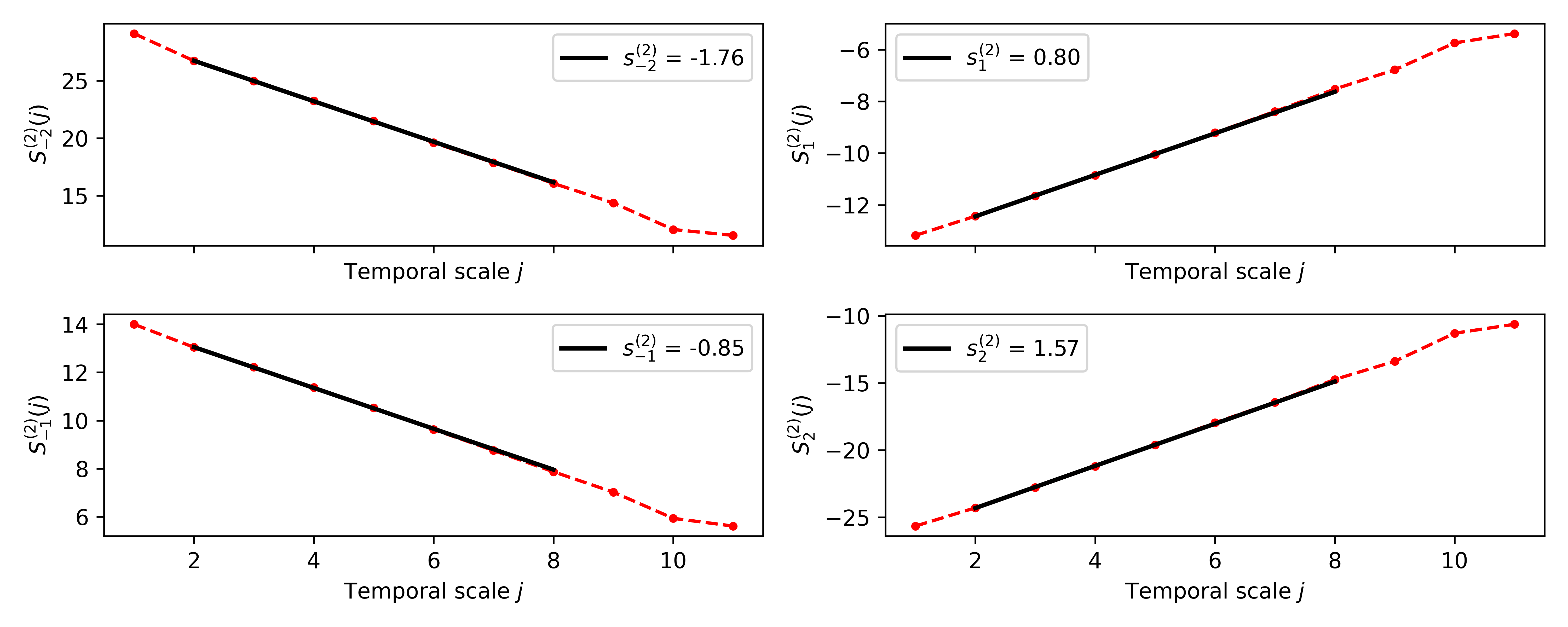
The structure functions \(S_q(j)\) and their associated exponents may be
visualized using the StructureFunction.plot() method
pwt.structure.plot(figsize=(10, 4), nrow=2)
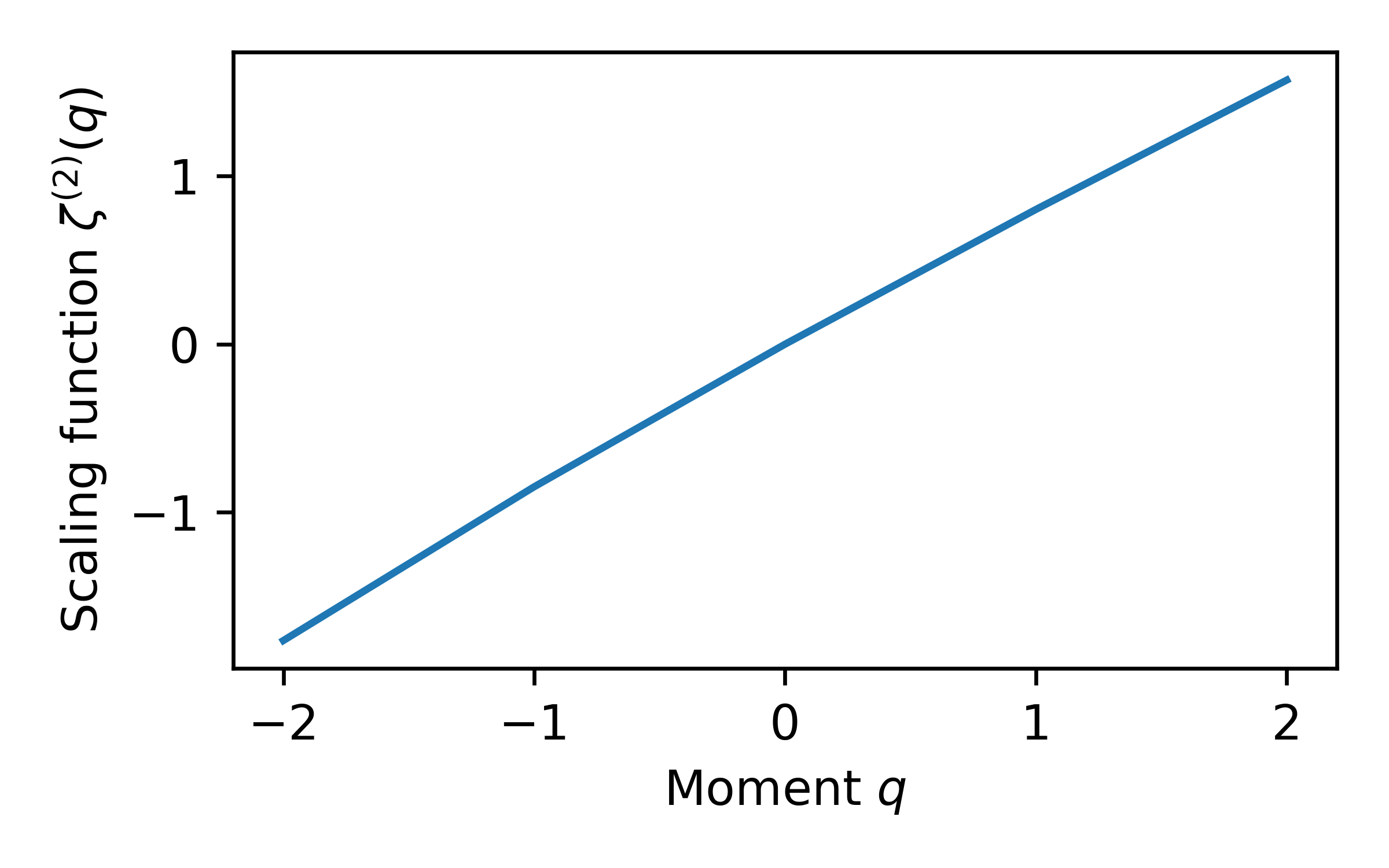
We can plot \(\zeta(q)\) using the StructureFunction.plot_scaling()
method
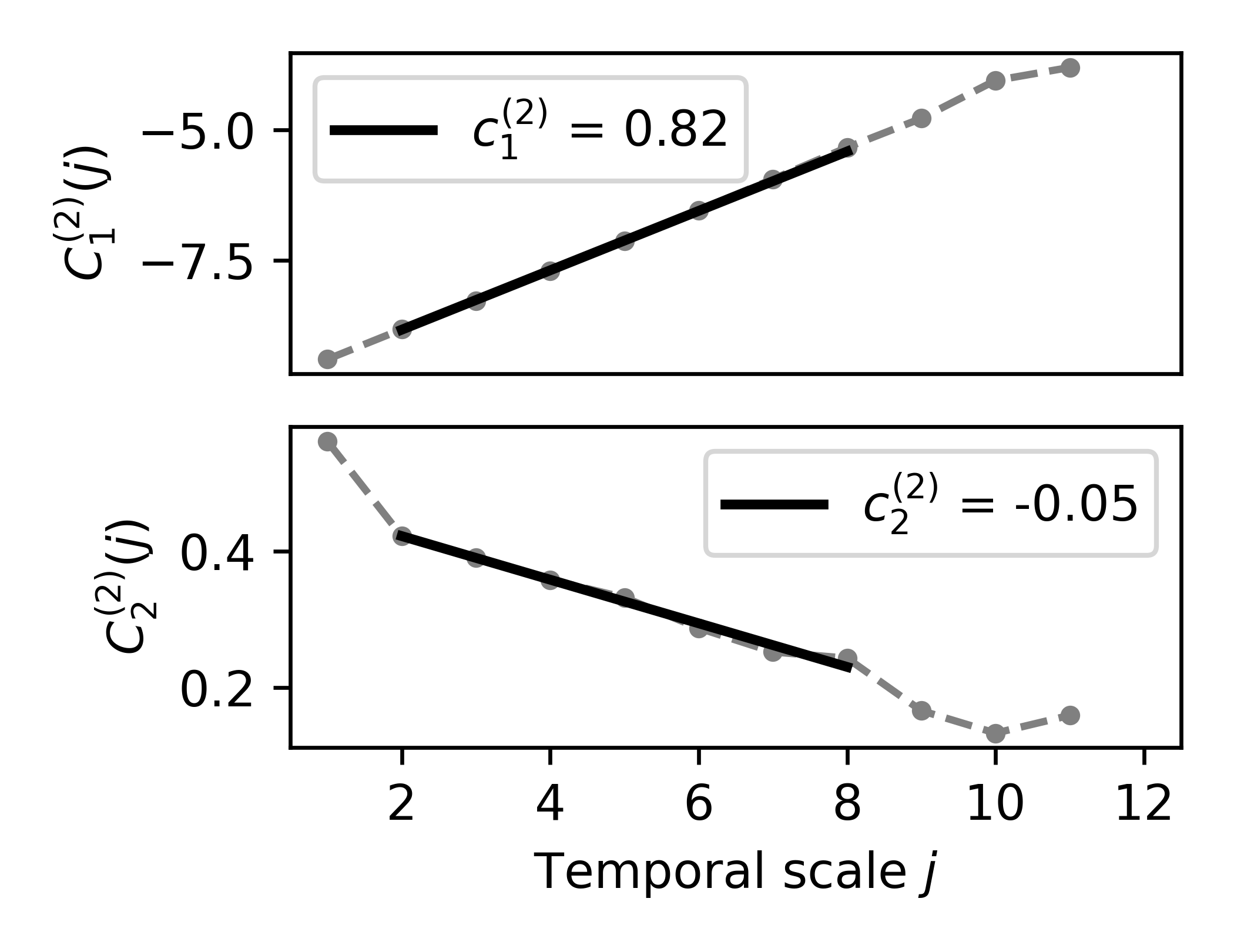
Cumulants
The cumulant scaling functions may be visualized using
Cumulants.plot()
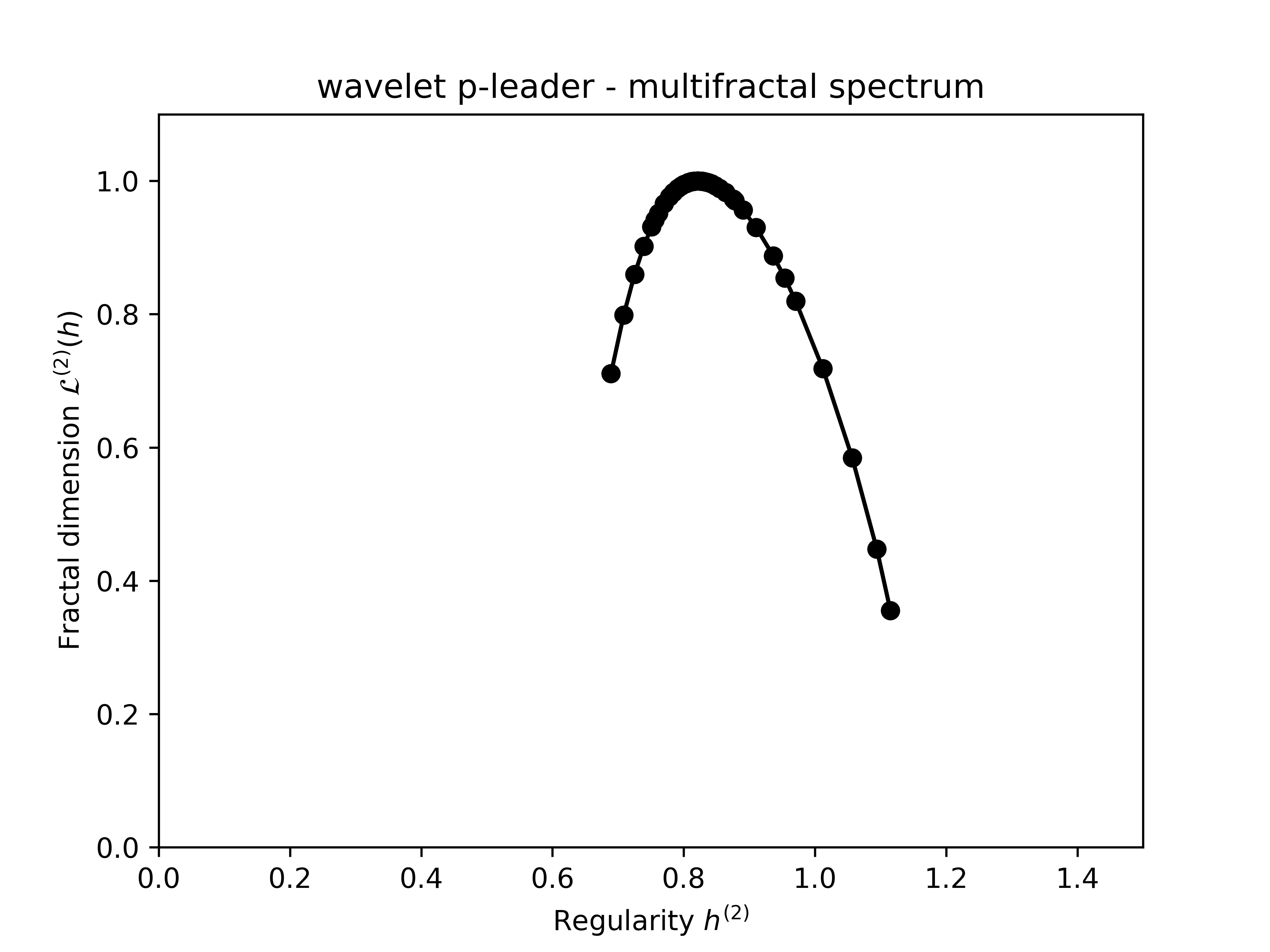
Multifractal spectrum Visualizing the multifractal spectrum requires more densely sampled values of \(q\):
pwt = mfa(WTpL, scaling_ranges, weighted='Nj', q=build_q_log(.1, 5, 20))
pwt.spectrum.plot()
Total running time of the script: (0 minutes 8.529 seconds)